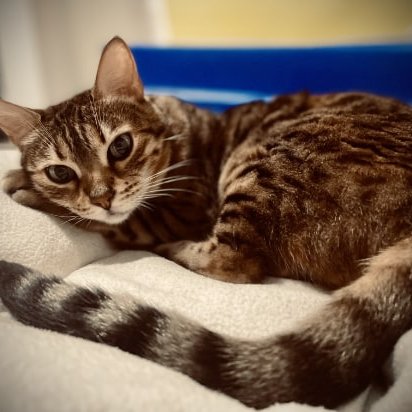
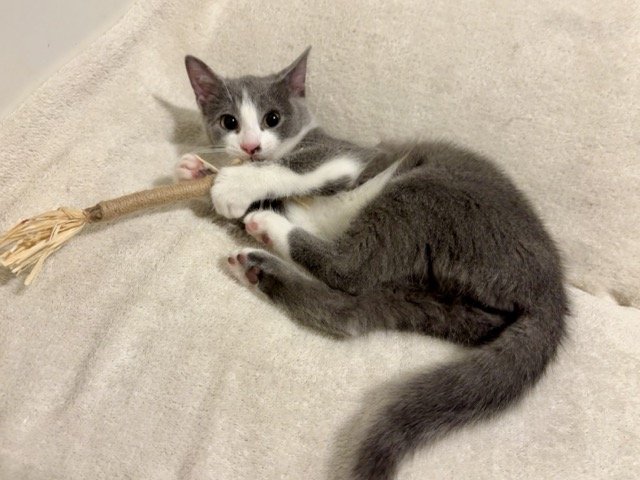
We were looking for a kitten with a particular temperament for our two cats with very different energies, one with a playful streak, the other with a more reserved nature. We used to have this in our old bengal cat River, but she passed away this past January, and we came to see that she helped keep the peace and make the lives better for our other two cats. Being full believers in the motto, "Adopt, don't shop," we poured through rescues to see if we could find the right fit. We found our fit, but took on a lot more than we bargained for.
Enter Tendi (Formerly Know as 'Rafa')
I found a wonderful candidate through a FB post by Biscuits and Purrs, who had the kitten currently available for meet and greets at the PetSmart in Barrhaven. That day, I contacted the organization and they immediately processed and approved my application, and the next day I drove an hour out to Ottawa from our home in Burnstown to meet the kitten. She was lovely and energetic and ticked all the boxes. We decided to adopt her.
As soon as our adoption application was processed and our payment was taken, they asked us to go pick her up. I had no idea they would do this so quickly and require us to go back out to get her immediately. We had to prepare a room for her isolation period from the other cats. I also wanted to be able try and get her seen by a vet before taking her home to make sure she was safe to be around our cats and didn't have any communicable infections, etc. They insisted that once a cat is adopted they expect us to come and get her, so we made arrangements to do as asked.
When we got her home the following evening, we both noticed that she had some flaky skin on her ear that she was scratching at. Neither of us thought anything of it because we simply weren't aware of what it could have been. It wasn't until a friend who was a vet tech came over the next day and met the cat. We pointed it out and asked if we should be concerned and she told us we need to get her to a vet and have it checked out because she thought it could be ringworm. I reached out to the foster who I had contacted to discuss Tendi's temperament prior to adoption to ask if she knew anything about it. She told me that she hadn't seen anything and told me the kitten had been recently checked by a vet before going to PetSmart, saying that sometimes cats are exposed to things by the humans that handle them at the stores. We made an appointment immediately and got her in to see the vet who did a variety of tests, which revealed that it was indeed ringworm.
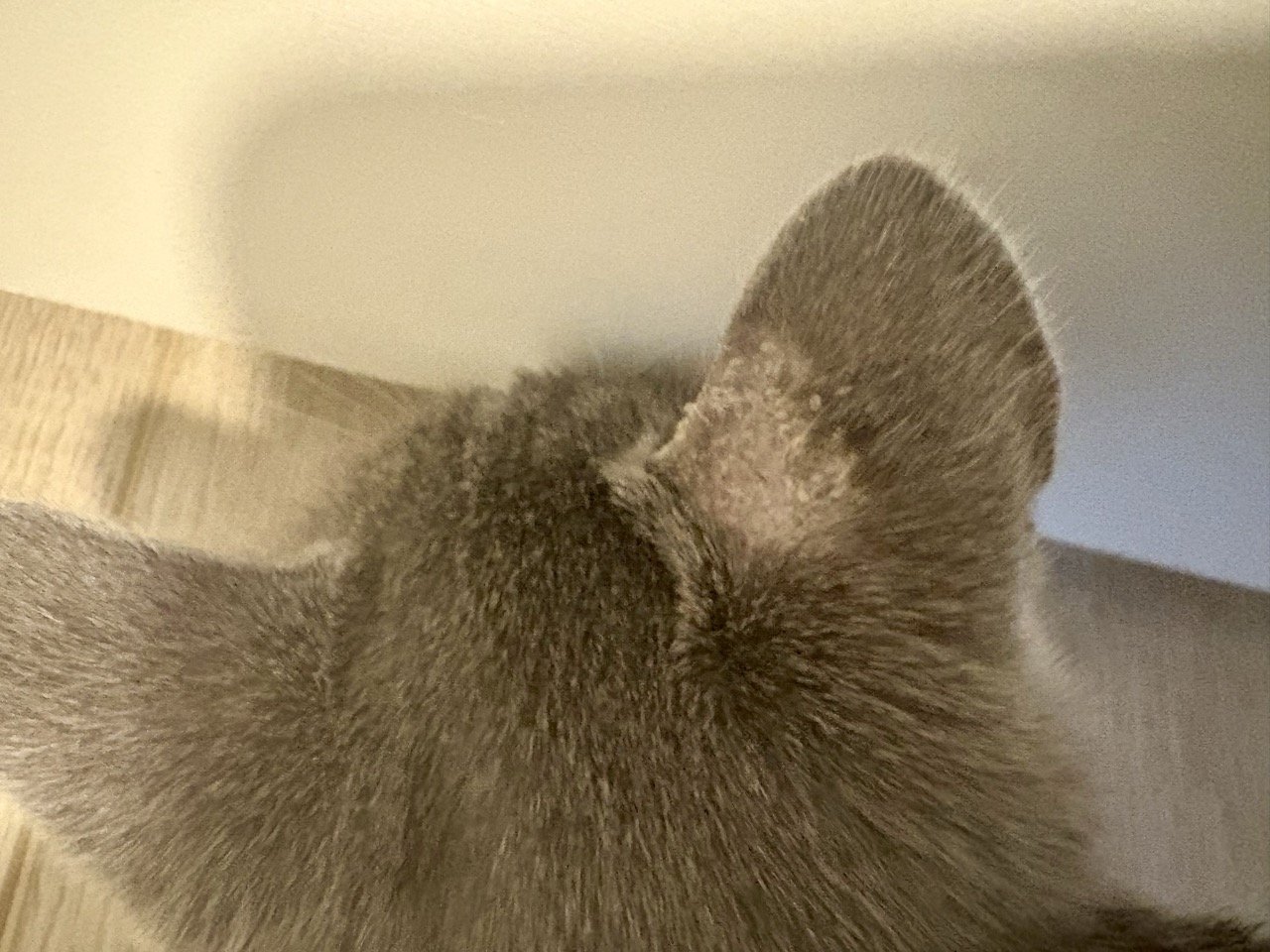
Dealing with Ringworm in Cats
Contrary to the name, ringworm isn't a parasite. It is a fungus, and it isn't something that is quickly/easily treated and contained. It is highly contagious and communicable to other cats, dogs, and humans, particularly children and people who are immunocompromised, or when it is exposed to damaged skin.
While it is treatable with topical creams, shampoos and oral medication, and cats can make a full recovery from it, you still need to isolate the cat in an easily cleanable room to prevent it from spreading to other household members. You also need to limit interaction with the affected cat, and wear gloves and protective clothing when you do. You also need to do daily vacuuming/floor cleaning and launder all blankets, beds, etc, and do a full disinfection of the room 2-3 times a week, which involves going over all the surfaces with a 10-1 bleach to water solution to eliminate spores and prevent them from spreading and steam cleaning any carpets or upholstered furniture, etc.
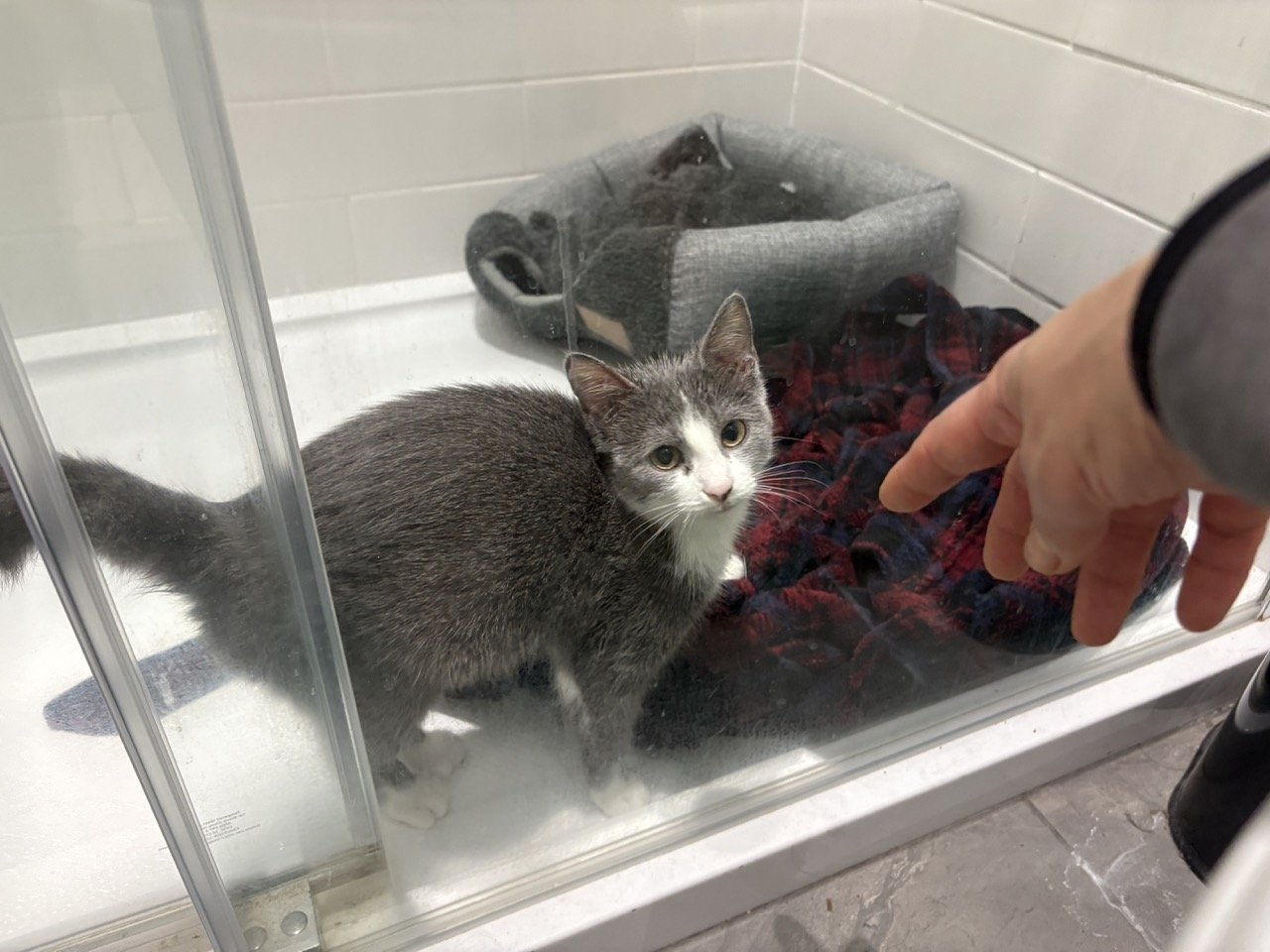
With aggressive treatment, a cat could be healthy again in as little as 3 weeks, but to be sure, vets recommend that the cat have two negative culture tests to confirm they are safe to return to a more normal living situation. But because this can take time to achieve, you could be looking at anywhere between 4-6 weeks before things can be back to normal.
Heartbroken and Seeking Support
Forgetting about all the hassle and expense of having to now care for a kitten with ringworm, the part that bothers us the most is not being able to love on our new kitten who is now in a new, unfamiliar place alone in a room. She doesn't understand that we love her and want to hold her and be there for her. All she knows is that she went from being around other cats at her foster home to now being isolated. While she is pretty confident and is good at self-play, and we have done our best to give her plenty of toys and activities to keep her stimulated while she's in isolation, it still breaks our heart when we go in to spend time with her with our gloves on, and have to limit how much we can hold and touch our affectionate little sweetie who is aggressively trying to bunt and nuzzle us. It hurts to have to push her face away when all she wants is love, and to hear her crying out to us when we have to leave her alone in the room, knowing that it could be many weeks before we can start integrating her into our household fully.
Because this was a condition she had before we took her home, I was advised by my vet tech friend and by others who work with rescues to reach out to the rescue and ask for whatever support they might be able to offer. They told me most rescues will do this when it is something that they had before the cat was brought home. I was also concerned that if my kitten had ringworm, then the other cat that was with her in the enclosure, Gingersnap, was definitely exposed, and because ringworm has an incubation period of 4-14 days, also any cats or dogs she was exposed to at the foster's home (there were 12 other cats and several dogs in the home) could have also been exposed, or the original carriers.
I emailed Biscuits and Purrs to inquire about this, and to make sure that steps were being taken to inform people of the potential exposure, also asking if they could call me, but I got no reply. I only got an email reply after I sent a second email a day later asking if they received my message as it was urgent to ensure that the fungus is not spread. They replied with a very generic response, not by a specific human with a name, but from "The BPCR Admin team", saying that it was unfortunate, but cats can be exposed to things by the humans that handle them at PetSmart and that they are essentially not responsible for our cats medical expenses, which was "explicitly stated" in our contract.
They simply stated: "Just as with other rescues or shelters, adopters don't have the opportunity to take cats to their own vet prior to bringing them home. Rather, we strongly encourage isolation to ensure protection and adaptation. We also find this distressing as we go through considerable efforts to make sure our cats are as healthy as possible when they are placed for adoption." While this is true, some rescues, like the Ottawa Humane Society, has a 14-day health guarantee. They also get a health check prior to adoption, parasite screening and treatment (including a Woods lamp examination to check for ringworm), and are even tested for FIV/FELV. Hungry and Homeless Cat Rescue, also operating in Ottawa, states in their adoption contract that they will "ensure that the animal has been checked by a veterinarian for signs of Infectious conditions, skin irritations i.e., rash/missing fur, parasitic infestation, as well as severe depression or behavioural problems." Even Dickies' Kitten Rescue has a 30-day health guarantee and they aren't even a registered charity. She is a one-woman operation who works hard to tightly oversee all the cats that are fostered for her organization.
Of course not all rescues are able to offer this level of care, the Ottawa Stray Cat Network offers an initial veterinary health check, and states that "if a condition comes up within the first 30 days of adoption and, with pre-approval, we will work with you to schedule a wellness checkup at one of our partner animal hospitals." Furry Tales, also offers a vet check, included in their adoption fees.
Still other organizations like Arnprior Regional Cat Rescue offer the option to "foster to adopt", which is ideal especially if you have other animals in the house and you want to make sure they get along, but also allows you time to bring the cat to a vet to be checked out before taking them out of isolation and allowing them to meet your resident animals. This is an option we had inquired about with Biscuits and Purrs, but they simply did not offer it as an option. Although not all rescues will mention it on their website, some of them do offer the option to foster-to-adopt, particularly if it is a household with other cats.
Doing My Due Diligence
I reached out a second time when Biscuits and Purrs didn't make any statement about whether or not they were contacting the necessary people to help prevent spread of the ringworm. Again, they didn't reply right away so I sent a second email asking that they confirm they got my email based on the urgency. They then only replied with very broad statements about who they contacted about the ringworm saying that they "have protocols in place to appropriately inform individuals of health concerns, and the spaces in which our cats are enclosed are always thoroughly sterilized between occupants." Because this is very easily open to their interpretation of whether or not it is "appropriate", so I also reached out to the PetSmart where she was being shown before we adopted her. I am also sharing this post as widely as possible on social media, with the hope of reaching anyone who adopted other cats that were featured at that PetSmart location whom she may have been in contact with (I was told that she had played with other kittens in addition to being housed with Ginger Snap) on the week of Nov. 17.
I do appreciate that Biscuits and Purrs has done a lot to help many cats and kittens get out of terrible living conditions and safely into adoptive homes, and part of me was hesitant to do anything about this because of that. But when rescues have gaps in their safety protocols, it not only impacts the humans adopting cats with unexpected expenses and heartbreak. It can also impact their health and safety, as well as any other pets in their care, as it would in our case with the ringworm infection. Not only that, it harms people's confidence in the whole system of animal rescue. It only takes one bad experience to turn a person away from pet adoption, or for that person to share their cautionary tale with others.
I was informed that they have signs up at the stores where their cats are featured telling people to sanitize their hands before handling, but sometime people slip through the cracks. I'm sure there was a sign, but I never saw it myself. I did see the hand sanitizer and sanitized my hands before touching the cats, but I only did that because I know how important it is, especially for kittens who are have more vulnerable immune systems. At the end of the day, a sign alone isn't enough and they really should be instructing their volunteers to not let anyone let visitors know they have a strict policy and not let anyone touch the cats without seeing them sanitize their hands first. Having this practice in place could have very well stopped this our kitten from having gotten infected. That being said, ringworm has an incubation period of 4-14 days so she very well could have had it before she got there in the first place, without showing signs of it. If the volunteer was trained to spot any aberrations, before letting a new family take a kitten home, like the rescue told me they were trained to do, the one who handled the finalization of my adoption did not do that, or if she did, she missed a pretty obvious warning sign as it was pretty evident on the ear and she should have contacted the rescue about it asap. I do understand that B&P do make efforts to try and ensure cats are healthy, but their policies simply aren't tight enough to stop this situation from occurring, a situation that could have been easily prevented at multiple points. I hope that by sharing my story, it will also motivate Biscuits and Purrs and other rescue agencies with similar policies to adopt stricter policies and to have animals vet checked, and kept in isolation after the check, before adopting them out, a practice that is common amongst over agencies.
Still Pro-Adoption but with Caution
I am still pro-adoption, but I want to share our story as a cautionary tale to help keep people from getting stuck in a situation that can easily be prevented. So here is my advice: Choose your rescue wisely. Get all the details of what medical checks and treatments are provided before you adopt any animal, as well as any health guarantees that are provided. If none of these things are offered, ask if you can arrange for a vet visit prior to pick-up, and for the cat to be kept in isolation before pick-up. Another option is to ask for a foster-to-adopt option then keep the cat in isolation until you are able to have it checked by a vet.
I know it's tempting to fall in love with a cat or kitten, and want to rush to take them home for fear of you losing your chance to adopt them to another adopter, but if you're concerned about making sure your cat is healthy and want to prevent all the fallout that can come with adopting a cat with a major health concern, it's important to take measures to protect you and your household members. I am not saying that people shouldn't necessarily adopt form a rescue with policies like Biscuits and Purrs, as I am sure that the vast majority of their cat adoptions have happy endings, but If a rescue isn't willing to make allowances for you to take measures for your protection, even at your own expense, then you should know that is a risk you are choosing to take.